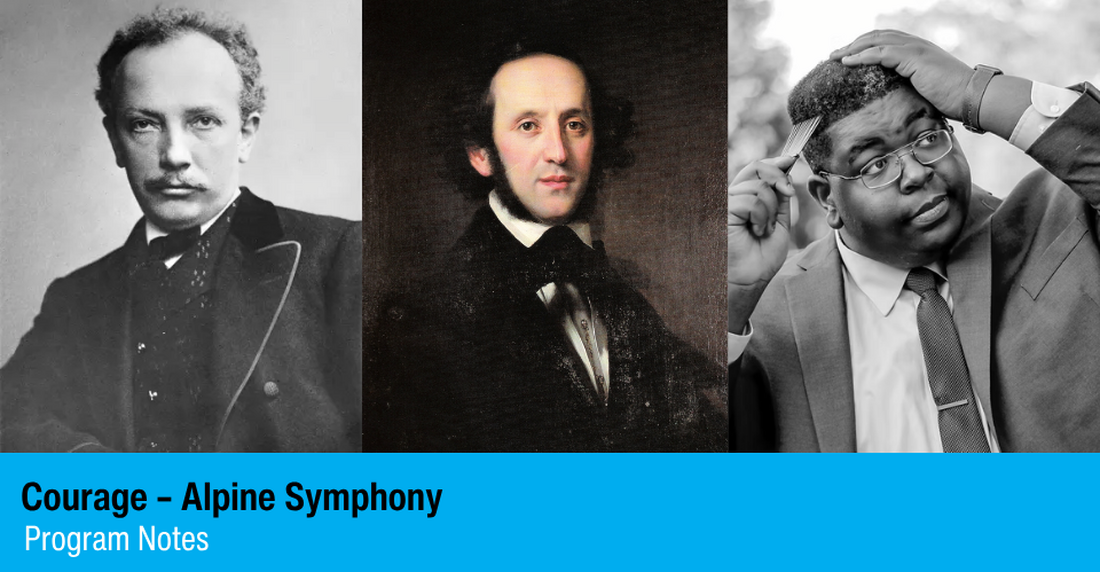
30 SECOND NOTES: The extremes of Richard Strauss’ brilliant writing for orchestra frame this Des Moines Symphony concert. The program opens with the brief Fanfare for the Vienna Philharmonic, an orchestra Strauss conducted often, written for the ensemble’s 1924 Fasching (Mardi Gras) ball. An Alpine Symphony, the concert’s closing work, requires one of the largest instrumental contingents of any piece in the repertory — some 100 musicians on stage, plus a dozen brass in the wings and a percussion section that includes cow bells and a wind machine. With its enormous personnel requirements, performances of An Alpine Symphony are infrequent, so this program offers a rare opportunity to experience the full power and limitless colors that Strauss could summon from a symphony orchestra. Katahj Copley, whose works have been performed and commissioned by colleges, universities, organizations and ensembles across the United States and internationally, imputes both astronomical and social associations to his Equinox, composed in 2021 for his hometown orchestra in Carrollton, Georgia. Joseph Joachim, one of the 19th-century’s greatest violinists, said, “The Germans have four violin concertos. The greatest, the one that makes the fewest concessions, is Beethoven’s. The one by Brahms comes closest to Beethoven’s in its seriousness. Max Bruch wrote the richest and most enchanting of the four. But the dearest of them all, the heart’s jewel, is the Violin Concerto by Felix Mendelssohn.”
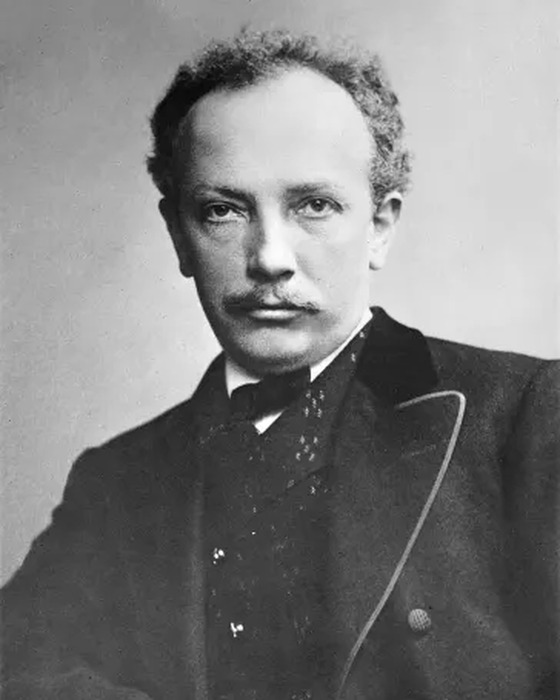
RICHARD STRAUSS
Born June 11, 1864 in Munich; died September 8, 1949 in Garmisch-Partenkirchen.
Fanfare for the Vienna Philharmonic
- First performed on March 4, 1924 in Vienna, conducted by the composer.
- First performed by the Des Moines Symphony on May 9 & 10, 1998 with Donald Hunsberger conducting.
(Duration: ca. 3 minutes)
Richard Strauss is remembered today as a master composer, but he was also one of the most celebrated conductors of his day, and he enjoyed a long and fruitful relationship with the Vienna Philharmonic, leading the ensemble in many concerts at home and on a tour of South America in 1924, and working closely with it during his years (1919-1924) as co-director of the Vienna State Opera (for which the Philharmonic is the house orchestra). For the Orchestra’s ball held on the Fasching holiday (Mardi Gras in other countries) of March 4, 1924, a highlight of Vienna’s annual social calendar, Strauss composed the majestic Fanfare for the Vienna Philharmonic for brass and timpani.
Score written for eight horns, six trumpets, six trombones, two tubas and two timpani.
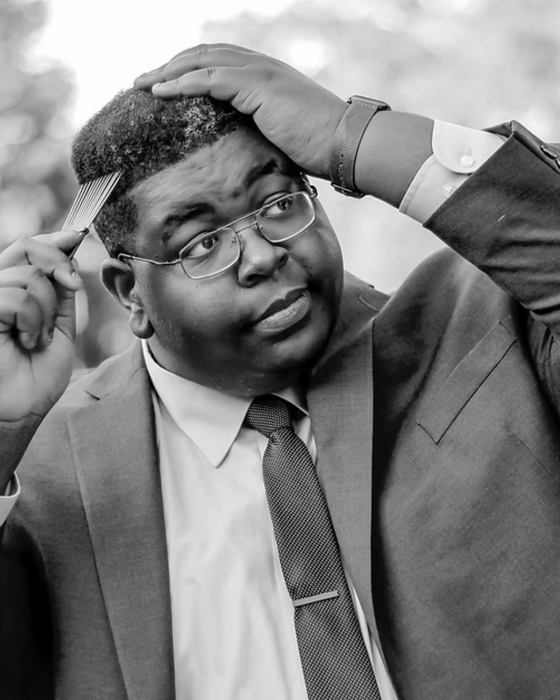
KATAHJ COPLEY
Born January 15, 1998 in Carrollton, Georgia.
EQUINOX
- First performed on February 10, 2022 in Carrollton, Georgia by the Carroll Symphony Orchestra, conducted by Terry Lowry
- These concerts mark the first performances of this piece by the Des Moines Symphony.
(Duration: ca. 7 minutes)
“Georgia native Katahj Copley,” according to the composer–saxophonist–educator’s web site, “premiered his first work, Spectra, in 2017 [when he was nineteen] and hasn’t stopped composing since.” Copley was born in 1998 in Carrollton, Georgia, fifty miles west of Atlanta, and earned Bachelor’s Degrees in both Composition and Music Education at the University of West Georgia before completing a Master of Music in composition at the University of Texas at Austin; he is currently a doctoral composition student at Michigan State University. Since his debut as a composer in 2017, Copley has written more than 100 works for orchestra, wind band and chamber ensembles that have been performed and commissioned by colleges, universities, organizations and ensembles in the United States, Canada, United Kingdom, Japan, China and Australia; his Nova was premiered by the University of West Georgia Wind Ensemble at the 2019 College Band Directors National Association Southeast Division Conference, and Sunshine was featured at the 2020 Georgia Music Educators Association’s Conference. Katahj Copley is one of eight founding members of Nu Black Vanguard, a composers collective dedicated to the promotion and advancement of Black composers.
Copley wrote of his spirited and uplifting Equinox, composed in 2021 and premiered by the Carroll Symphony Orchestra in his Georgia hometown on February 10, 2022, “The definition of the word ‘Equinox’ is the moment when the plane of Earth’s equator passes through the geometric center of the Sun’s disk. This occurs twice each year, around March 20 and September 23. However, while writing this piece at the end of 2021, I became engaged with the symbolism of the word itself. In some cultures, the equinox represents the balance of life and death — of old and new. With this concept, I wanted the piece to embark on a journey of excitement, of trouble, and of wonder. Equinox begins with a huge, 16th-note motif that is felt throughout the work, suggesting adventure, risk and, at some moments, danger. Then the main theme enters as a guide throughout this journey. From mystery to danger, Equinox moves with a lyrical texture that gives the feeling of excitement and happiness, of not knowing where life will take you.”
Score written for piccolo, two flutes, two oboes, two clarinets, bass clarinet, two bassoons, contrabassoon, four horns, three trumpets, three trombones, tuba, timpani, marimba, tam-tam, glockenspiel, tambourine, xylophone, vibraphone, bass drum, triangle, anvil, snare drum, piano, harp and the usual strings, consisting of first violins, second violins, violas, violoncellos and double basses.
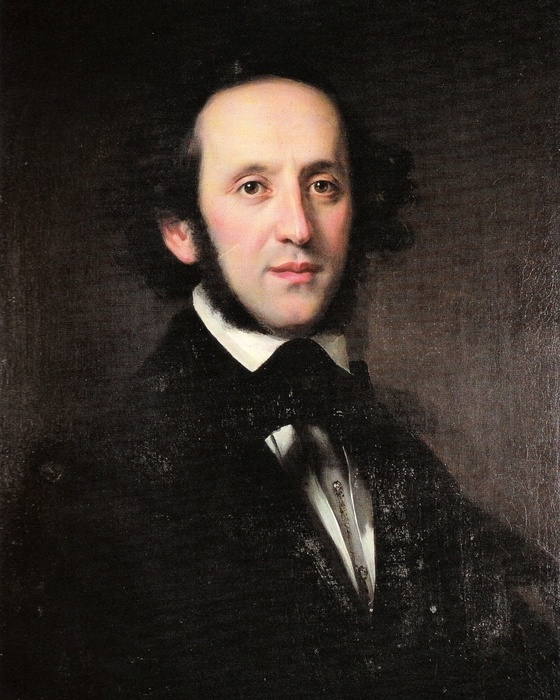
FELIX MENDELSSOHN
Born February 3, 1809 in Hamburg; died November 4, 1847 in Leipzig.
Violin Concerto in E minor, Op. 64
- First performed on March 13, 1845 in Leipzig, conducted by Niels Gade with Ferdinand David as soloist
- First performed by the Des Moines Symphony on May 1, 1938 with Frank Noyes conducting and Scipione Guidi as soloist. Eleven subsequent performances occurred, most recently on February 8 & 9, 2020 conducted by Peter Oundjian with Grace Park as soloist.
(Duration: ca. 25 minutes)
“I would like to compose a violin concerto for next winter,” Mendelssohn wrote in July 1838 to his friend, the violinist Ferdinand David. “One in E minor keeps running through my head, and the opening gives me no peace.” It was for David that Mendelssohn planned and wrote his only mature Violin Concerto. Their friendship began when the two first met at about the age of fifteen while the young violinist was on a concert tour through Germany. They were delighted to discover the coincidence that David had been born only eleven months after Mendelssohn in the same neighborhood in Hamburg. Already well formed even in those early years, David’s playing was said to have combined the serious, classical restraint of Ludwig Spohr, his teacher, the elegance of the French tradition and the technical brilliance of Paganini. Mendelssohn, who admired both the man and his playing, saw to it that David was appointed Concertmaster of the Leipzig Gewandhaus Orchestra when he became that organization’s Music Director in 1835. They remained close friends and musical allies. When Mendelssohn’s health was feeble, David looked after much of the routine activity of the Gewandhaus, where he spent 37 years, and he even stepped in to conduct the premiere of Mendelssohn’s oratorio St. Paul when the composer was stricken during a measles epidemic in 1836.
The Concerto opens with a soaring violin melody whose lyricism exhibits a grand passion tinged with restless, Romantic melancholy. Some glistening passagework for the violinist leads through a transition melody to the second theme, a quiet, sunny strain shared by woodwinds and soloist. More glistening arabesques from the violinist and a quickened rhythm close the exposition. The succinct development section is largely based on the opening theme. The cadenza is used as a bridge to the recapitulation and leads seamlessly into the restatement of the movement’s thematic material. The thread of a single note sustained by the bassoon carries the Concerto to the Andante, a wordless song of warm sentiment and endearing elegance; the center section is distinguished by its rustling accompaniment and bittersweet minor-mode melody. A dozen measures of chordal writing for strings link Andante with the finale, an effervescent sonata form.
The score is written for flutes, oboes, clarinets, bassoons, horns and trumpets in pairs, timpani, the usual strings and solo violin.
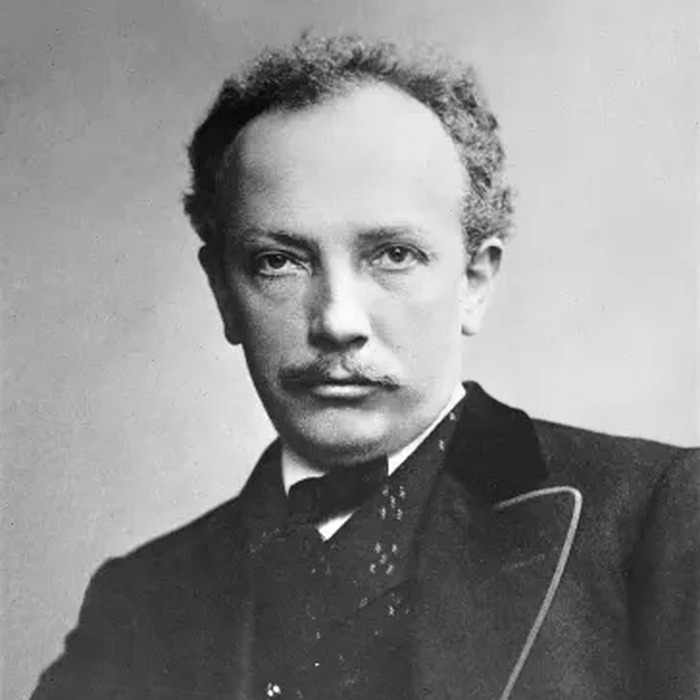
RICHARD STRAUSS
Born June 11, 1864 in Munich; died September 8, 1949 in Garmisch-Partenkirchen.
Eine Alpensinfonie (“An Alpine Symphony”), Op. 64
- First performed on October 28, 1915 in Berlin, conducted by the composer
- First performed by the Des Moines Symphony on May 9 & 10, 1998 with Joseph Giunta conducting.
(Duration: ca. 50 minutes)
Richard Strauss was born and raised in Bavaria, lived in the region for most of his life, and ultimately settled in the lovely twin towns of Garmisch-Partenkirchen, tucked beneath the northern face of the massive Zugspitze. As a teenager, he once went on an Alpine climb with a local group of hikers. The party lost its way during the ascent, and was overtaken and drenched to the skin by storms on the way down. Strauss wrote to his friend Ludwig Thuille (a composer and later professor of composition at the Munich Conservatory) that he had found the experience so exhilarating that he was inspired to improvise some musical impressions of the climb at the piano: “Naturally it conjured up a lot of nonsense and giant Wagnerian tone-painting.” It was not until 1900, more than two decades later, that Strauss again broached the subject of his mountain music. Soon after finishing Ein Heldenleben, he wrote to his parents that he was considering a tone poem “that would begin with a sunrise in Switzerland. Otherwise so far only the idea (love-tragedy of an artist) and a few themes exist.” It was just at that time, however, that his creative energy shifted from the concert hall to the opera stage, and, except for his 1904 paean to life among the pots and pans, the Symphonia Domestica, all of his compositions for the next dozen years were operas.
Der Rosenkavalier was premiered with great success at Dresden on January 26, 1911, and Strauss was eager to follow it quickly with other stage works. However, his librettist, Hugo von Hofmannsthal, a meticulous and thoughtful writer, found it impossible to produce a new book on such short notice. Since Strauss was not one to take potential inactivity sitting down (he called the Oboe Concerto and the Duet-Concertino, composed when he was in his eighties, “wrist exercises ... to prevent my right wrist from going to sleep prematurely”), he sketched out a fifty-minute Alpine Symphony early in 1911, “though,” he confessed, “it gives me less pleasure than shaking maybugs off trees.” Despite such initial reluctance, however, much of the new work was sketched during the spring and early summer before he turned to the composition of incidental music for Molière’s Le Bourgeois Gentilhomme, which five years later grew into the iridescent opera Ariadne auf Naxos. Strauss occasionally tinkered with the Symphony during the following years, but he did no serious further work on it until November 1914, when Hofmannsthal was (again) keeping him waiting for the final act of Die Frau ohne Schatten. The polishing and orchestration of Eine Alpensinfonie took exactly 100 days; the work was completed on February 8, 1915. Except for the Japanische Festmusik of 1940, a political potboiler celebrating the 2,600th anniversary of the Japanese Empire, it was to be his last composition for large orchestra.
Though this work is labeled as a “symphony” — and many learned commentators have tried to squeeze its single musical span into Classical sonata-allegro or Lisztian four-movements-in-one — Eine Alpensinfonie is unabashedly a tone poem, the most explicit example of the genre Strauss ever created. The score bears no fewer than 22 graphic phrases attached to its various sections, representing Alpine vistas, the phenomena of nature, and the progress of the climber. It is a piece almost entirely concerned with external depiction rather than with the expression of the intense states of personal emotion that marked Death & Transfiguration, Don Juan, Also Sprach Zarathustra and other of his earlier orchestral works. For this, Strauss was (and continues to be) criticized, though the consummate craftsmanship of the work’s scoring and the manner in which he achieved his pictorial goal are beyond reproach.
An Alpine Symphony is concerned with a period of 24 hours upon the mountain. The work opens with the shimmering stillness of Night and mounts an enormous crescendo to prepare for Sunrise. The Ascent commences with an energetic, wide-ranging theme. A blast of hunters’ horns in the distance marks the Entry into the Forest. A lugubrious theme in horns and trombones suggests dense foliage, from which float the songs of birds. The ascent resumes and the climber finds himself Wandering by the Brook, which, upstream, leads to a Waterfall. In the mist above the whirlpool appears an Apparition. The traveler then comes to Flowery Meadows and The Mountain Pasture. Next is Through Thicket and Undergrowth by the Wrong Way, only to emerge On the Glacier. Crossing the ice, the traveler has some Dangerous Moments before he arrives On the Summit. Quickly, The Sun Gradually Becomes Obscured. There is a brief Elegy, which is interrupted by the Calm Before the Storm. The traveler contends with Thunder and Storm during his Descent. The storm breaks in time to reveal the day’s Sunset, and An Alpine Symphony closes with an introspective Epilogue and the return of Night.
The score calls for quadruple flutes, oboes, clarinets and bassoons plus two piccolos, English horn, Heckelphone (bass oboe), E-flat clarinet, bass clarinet and contrabassoon; four horns, four trumpets, four trombones, four Wagner tubas and two bass tubas, two sets of timpani, bass drum, cymbals, snare drum, glockenspiel, triangle, tam-tam, wind machine, thunder sheet, almglocken, two harps, organ, celesta, and the usual strings; plus and an additional off-stage banda contingent of twelve horns, two trumpets and two trombones.