30 SECOND NOTES: Appalachian Spring by Aaron Copland is among the most frequently performed American works, but its best-known theme is not by him. That melody, Simple Gifts, is a Shaker hymn whose music and words were written in 1848 by Joseph Brackett, Jr., leader of the Sabbathday Lake community in Maine — ’Tis the gift to be simple, ’tis the gift to be free/’Tis the gift to come down where we ought to be,/And when we find ourselves in the place just right,/’Twill be in the valley of love and delight. The John and Mary Pappajohn Sculpture Park is one of America’s greatest gatherings of public art. On commissions from the Des Moines Symphony, Minnesota composer Steve Heitzeg created musical evocations of eighteen of its works in three Symphonies in Sculpture, which the Des Moines Symphony premiered and recorded on a three-DVD set. Chicago-born composer, pianist and social activist Margaret Bonds was the first African-American soloist to appear with the Chicago Symphony Orchestra. She composed her Montgomery Variations, based on the spiritual I Want Jesus to Walk with Me, in response to the racially motivated firebombing in Birmingham, Alabama in 1963, the height of the Civil Rights Movement, in which four young girls at Sunday School were killed and dozens of parishioners injured. George Gershwin conceived An American in Paris on a visit to that city in 1926, but he composed most of the score during a tour of Europe from March to June 1928, when he renewed acquaintances in London, hobnobbed with Milhaud, Prokofiev, Poulenc, Ibert, Ravel and Boulanger in Paris (Ravel turned down Gershwin’s request for some composition lessons, telling him that anybody making as much money as he did hardly needed instruction), and met Berg, Lehár and Kálmán in Vienna.
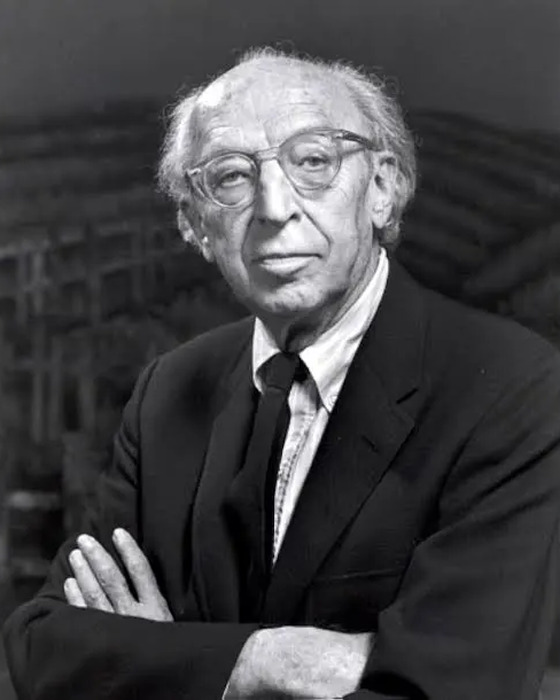
AARON COPLAND
Born November 14, 1900 in Brooklyn, New York; died December 2, 1990 in North Tarrytown, New York.
Suite from Appalachian Spring
- Ballet first performed on October 30, 1944 in Washington, D.C.; Suite premiered on October 4, 1945 in New York, conducted by Artur Rodzinski.
- First performed by the Des Moines Symphony on April 12, 1970 with Willis Page conducting. Six subsequent performances occurred, most recently on November 12, 2020 with Joseph Giunta conducting.
(Duration: ca. 24 minutes)
Mrs. Elizabeth Sprague Coolidge, one of America’s greatest patrons of the arts, went to see a dance recital by Martha Graham in 1942. So taken with the genius of the dancer-choreographer was Mrs. Coolidge that she offered to have three ballets specially written for her. Miss Graham chose as composers of the music Darius Milhaud, Paul Hindemith and an American whose work she had admired for over a decade — Aaron Copland. In 1931, Miss Graham had staged Copland’s Piano Variations as the ballet Dithyramb, and she was eager to have another dance piece from him, especially in view of his recent successes with Billy the Kid and Rodeo. She devised a scenario based on her memories of her grandmother’s farm in turn-of-the-20th-century Pennsylvania, and it proved to be a perfect match for the direct, quintessentially American style that Copland espoused in those years. Edwin Denby’s description of the Ballet’s action from his review of the New York premiere in May 1945 was reprinted in the published score: “[The Ballet concerns] a pioneer celebration in spring around a newly built farmhouse in the Pennsylvania hills in the early part of the 19th century. The bride-to-be and the young farmer-husband enact the emotions, joyful and apprehensive, their new domestic partnership invites. An older neighbor suggests now and then the rocky confidence of experience. A revivalist and his followers remind the new householders of the strange and terrible aspects of human fate. At the end, the couple are left quiet and strong in their new house.”
Score written for flutes, oboes, clarinets, bassoons, horns, trumpets and trombones in pairs, timpani, bass drum, cymbals, snare drum, tabor, glockenspiel, xylophone, triangle, woodblock, claves, harp, piano and the usual strings, consisting of first violins, second violins, violas, violoncellos and double basses.
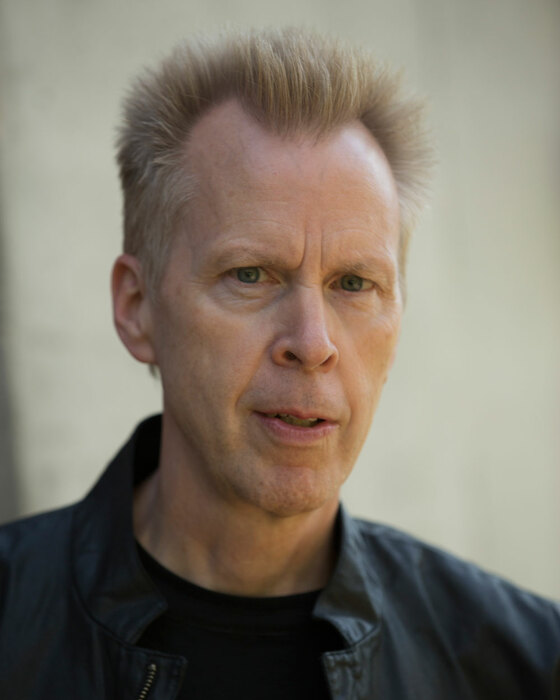
STEVE HEITZEG
Born October 15, 1959 in Albert Lea, Minnesota.
Suite from Symphony in Sculpture
- First performed on September 29, 2012 and October 12, 2019 by the Des Moines Symphony, conducted by Joseph Giunta.
(Duration: ca. 23 minutes)
Steve Heitzeg grew up in Minnesota on a dairy farm. By age eight, he was playing guitar and piano; he began composing in high school with a rock opera titled P.S., based on the parable of the Prodigal Son. From 1978 to 1982, Heitzeg attended Gustavus Adolphus College in St. Peter, Minnesota, where he received his Bachelor’s Degree in Music Education. He continued his professional training at the University of Minnesota’s School of Music in Minneapolis, completing his Ph.D. in Music Theory and Composition in 1986 as a student and teaching assistant of Dominick Argento. Heitzeg has taught and held residencies at Mankato State University, Gustavus Adolphus College and University of Saint Thomas in Saint Paul, served as library assistant with the Minnesota Orchestra, and created, organized and performed in the “Music of the Earth” Program for the Young Arts Program at the Walker Art Center in Minneapolis. Among Heitzeg’s honors are an Emmy Award for his score for the public television documentary Death of the Dream: Farmhouses in the Heartland, Bush Foundation Fellowship, McKnight Fellowship, Meet The Composer/Reader’s Digest-Lila Wallace Commissioning Grant, and multiple grants and commissions from the American Composer’s Forum, Meet the Composer, ASCAP and other organizations. He was named Minnesota’s “Composer of the Year” in 2000 by the Minnesota Music Academy.
Heitzeg has written orchestral, choral and chamber music in celebration of the natural world, with evocative and lyrical scores frequently including naturally found instruments such as stones, manatee and beluga whale bones, and sea shells. Since 1991, Heitzeg has also been creating what he calls “eco-scores” or “earth-scores,” which he defines as “music scores/drawings with an earth-centric or an environmentally based statement dedicated to the preservation of the many voices in nature.”
The three works titled Symphony In Sculpture comprise Steve Heitzeg’s musical impressions of works in the John and Mary Pappajohn Sculpture Park in downtown Des Moines which is owned and operated by the Des Moines Art Center. The compositions are dedicated to the Pappajohns, in the composer’s words, “for their vision and deep understanding of the power of art to change a culture and community in a positive way. My aspiration in ‘collaborating’ with the sculptures has been to portray them through sound, perhaps adding a further dimension to these intriguing works.” Heitzeg composed Symphony In Sculpture I for the 75th Anniversary Season of the Des Moines Symphony (2012-2013); the Symphony premiered the work on September 29, 2012 under the direction of Joseph Giunta, and the following year issued it as surround sound DVD accompanied by an original film created by Blur Media Works. Symphony In Sculpture II followed in 2015 and Symphony In Sculpture III in 2019, both also composed for the Des Moines Symphony, and also available on DVD.
The composer has supplied the following notes for each movement:
“Ancient Forest (Deborah Butterfield). When I met with John and Mary Pappajohn in Des Moines, Mr. Pappajohn mentioned that he had suggested to sculptor Deborah Butterfield that she might name her large horse sculpture — which the Pappajohns commissioned specifically for the new Sculpture Park — Bucephalus, the name of Alexander the Great’s horse. With a nod to the Pappajohns’ Greek heritage, I’ve begun this movement as a massive march, imagining the sound of Alexander the Great’s army on the move. I wanted the movement to reflect not only the power of Greek horses, but the Native American ponies of the Plains as well. What follows is a folk-infused dance of celebration to close the movement. Both Respighi’s Pines of Rome and Theodorakis’ film score for Zorba the Greek were models for this movement.”
“Spider (Louise Bourgeois). The thematic materials of this movement derive from LGBTQ (whose pitch equivalents are used prominently) since the sculptor Louise Bourgeois was an advocate for same-sex marriage and gay rights, creating several works late in her life to promote equality. Scored for strings only, this movement is in perpetual motion to symbolize spiders’ fabulous spinning and Louise Bourgeois’ active protest against inequality.”
“Post-Balzac (Judith Shea). ‘Is it nothingness or does a spirit reside? Music will certainly live inside …’ There is a sense of loss in the hollow space where a person should be inside Judith Shea’s sculpture. Yet there is also an evocation of comfort, even though the robe is cast in bronze and not soft fabric. To portray this, I have scored this movement in the exact instrumentation of Elgar’s Nimrod from the Enigma Variations, one of the most famous and beautiful Adagios ever composed.”
“Nomade (Jaume Plensa). Jaume Plensa’s sculptures share a deep respect for all cultures and reference the beautiful universality of the world in their inclusiveness, approachability and playfulness. To reflect this as well as the notion implied in the title of the sculpture that we are all nomadic, this movement begins with the sound of a shruti box drone, one of many transportable instruments employed here. (Similar to a harmonium, this small wooden instrument with a system of bellows frequently accompanies other instruments in Indian classical music. I have included an electronic shruti box in this work for its cross-cultural purposes. ‘Shruti’ means ‘hearing, revelation’ in Sanskrit.) Percussion instruments such as hand drums, finger cymbals, seed rattle and tambourine propel the movement and underscore the mixed-meter melody based on a synthetic scale. Celebration and dance abound, but they are interrupted by a searching, bittersweet melody that remains unresolved. The earlier dance theme returns briefly, then the work closes with the full orchestra expanding on the searching theme. While researching and composing this work I made several visits to the Pappajohn Sculpture Park. More than once, I have been asked to take photos of couples and families inside and in front of Nomade. Part shelter and part sculpture, there is something quite universal about this piece that draws people to it, emphasizing that we exist together on a beautiful planet. To me, the aura around Nomade is love, welcoming everyone in its space — no words needed, just like music.”
“LOVE (Robert Indiana). Robert Indiana’s iconic LOVE sculpture required that I compose a pop-infused movement; his LOVE print was created in 1965, the LOVE sculpture in 1970. This movement reflects on the various meanings of the word love, opening with a carefree melody and closing with the cyclical groove ‘Love More,’ inspired by [American soccer star] Megan Rapinoe’s eloquent speech on July 12, 2019: ‘This is my charge to everyone. We have to be better. We have to love more. Hate less.’ The youth choir sings this text with lush string chords and cascading piano riffs. Extra instruments include glass pop bottles, a 1970s electric Magnus chord organ, electric guitar and drum set.”
Score written for piccolo, two flutes, two oboes, English horn, two clarinets, bass clarinet, two bassoons, contrabassoon, four horns, three trumpets, three trombones, tuba, timpani, percussion (confirm with Rachel), harp, celesta, piano and the usual strings.
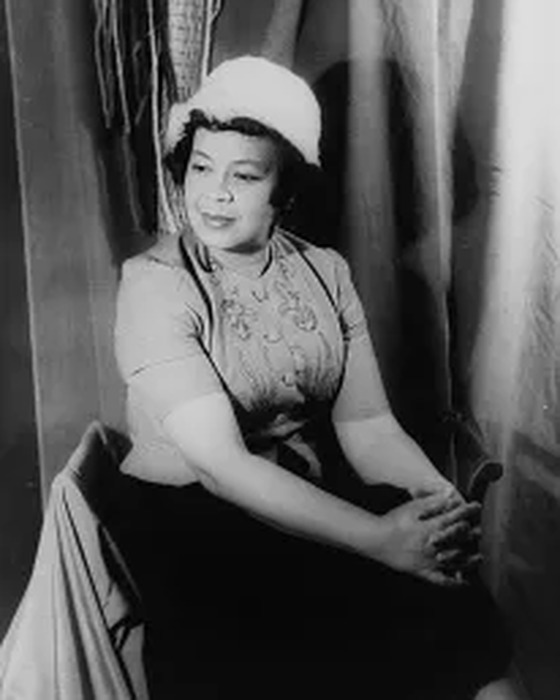
MARGARET ALLISON BONDS
Born March 3, 1913 in Chicago; died April 26, 1972 in Los Angeles.
MUSIC from Montgomery Variations
- Formally premiered on December 6, 2018 by the University of Connecticut Symphony Orchestra, conducted by Paul McShee. In 1967, Bonds’ friend choral conductor Albert McNeil led a performance of the work, probably in Los Angeles, though details are missing.
- These concerts mark the first performances of this piece by the Des Moines Symphony.
(Duration: ca. 15 minutes)
Margaret Bonds, born in Chicago in 1913, was the daughter of physician Dr. Monroe Alpheus Majors and organist and music teacher Estelle C. Bonds. (When she was divorced four years later, Estelle reclaimed her maiden name, and Margaret kept it for the rest of her life.) Margaret was immersed in music from an early age not just by her mother but also by the household’s many artistic visitors, including Florence Price, whose Symphony in E Minor became the first orchestral work by an African-American woman to be performed by a major American orchestra when Frederick Stock led its premiere with the Chicago Symphony Orchestra in June 1933. Bonds studied composition with Price and with William Dawson while still in high school, and subsequently won a scholarship to Northwestern University, where she earned both Bachelor’s and Master’s Degrees by age 21. She won the Wanamaker Foundation Prize for her song Sea Ghost while still an undergraduate, and became the first African-American soloist to appear with the Chicago Symphony Orchestra when she performed John Alden Carpenter’s jazzy Concertino on the same program as the premiere of Price’s Symphony in 1933. (Carpenter’s guest for that special concert, titled “Negro in Music,” which also included works by John Powell and Samuel Coleridge-Taylor, was George Gershwin, who was then negotiating the rights to base an opera on DuBose Heyward’s novel Porgy.)
Bonds concertized and founded the Allied Arts Academy for music and ballet in Chicago before moving in 1939 to New York, where she studied piano and composition at Juilliard (and privately with Roy Harris), served as music director for the Mount Calvary Baptist Church in Harlem and for several theaters, worked as a music editor, organized a chamber society to foster the work of Black musicians and composers, and performed. She also composed prolifically — works for orchestra, chorus, chamber ensembles, piano and theater, as well as art and popular songs and arrangements of spirituals (some of which were commissioned and recorded by Leontyne Price) — in a style that enriched the classical genres with the influences of jazz, blues, spirituals and her own social awareness.
In 1967, Bonds moved to Los Angeles to work at the Inner City Institute and Cultural Center. A month after she died unexpectedly, on April 26, 1972, Zubin Mehta conducted the Los Angeles Philharmonic in her last major composition, Credo for soloists, chorus and orchestra set to a text by W.E.B. DuBois, whose movements are titled: I believe in God … in the Negro race … in pride of race … in the devil and his angels … in the prince of peace … in liberty … in patience. Margaret Bonds’ work was recognized with awards from the National Association of Negro Musicians, National Council of Negro Women, Northwestern University Alumni Association, and American Society of Composers, Authors and Publishers.
Margaret Bonds’ Montgomery Variations, considered by many to be her masterpiece, was composed in the wake of the 1963 firebombing of Birmingham, Alabama’s 16th Street Baptist Church, a center for Black civil rights organizing and a target for white nationalists, in which four young girls at Sunday School were killed and dozens of parishioners injured. In the preface to the first publication of the score of the Montgomery Variations, in 2020, editor John Michael Cooper, Professor of Music at Southwestern University in Georgetown, Texas, wrote that the work’s vision went far beyond that one horrific event to encompass “the Montgomery bus boycott and other racial rights actions against Jim Crow segregation, as well as the backlash against them.” Bonds dedicated the score to Dr. Martin Luther King, Jr.
Bonds wrote, “The Montgomery Variations is a group of freestyle variations based on the Negro Spiritual I Want Jesus to Walk with Me. Because of the personal meanings of the Negro spiritual themes, over-development of the melodies is avoided.
“Decision. Under the leadership of Martin Luther King, Jr. and SCLC [Southern Christian Leadership Conference], Negroes in Montgomery decided to boycott the bus company and to fight for their rights as citizens.”
“March. The Spirit of the Nazarene marching with them, the Negroes of Montgomery walked to their work rather than be segregated on the buses. The entire world, symbolically with them, marches.”
“Dawn in Dixie. Dixie, the home of the Camellias known as ‘pink perfection,’ magnolias, jasmine and Spanish moss, awakened to the fact that something new was happening in the South.”
“Benediction. A benign God, Father and Mother to all people, pours forth Love to His children — the good and the bad alike.”
Scored for piccolo, three flutes, alto flute, two oboes, English horn, three clarinets, two bassoons, contrabassoon, four horns, three trumpets, three trombones, tuba, timpani, cymbals, tambourine, triangle, woodblock, log drum (consult with Rachel), harp and the usual strings.
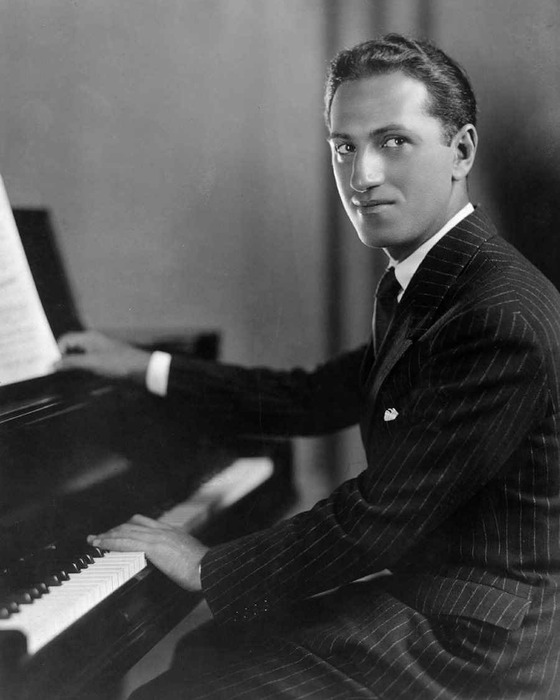
GEORGE GERSHWIN
Born September 26, 1898 in Brooklyn, New York; died July 12, 1937 in Hollywood, California.
An American in Paris
- First performed December 13, 1928 in New York, conducted by Walter Damrosch.
- First performed by the Des Moines Symphony on December 31, 1985 with Yuri Krasnapolsky conducting. Four subsequent performances occurred, most recently on September 24 & 25, 2022 with Joseph Giunta conducting.
(Duration: ca. 16 minutes)
In 1928, George Gershwin was not only the toast of Broadway, but of all America, Britain and many spots in Europe, as well: he had produced a string of successful shows (Rosalie and Funny Face were both running on Broadway that spring), composed two of the most popular concert pieces in recent memory (Rhapsody in Blue and the Piano Concerto in F), and was leading a life that would have made the most glamorous socialite jealous. The pace-setting Rhapsody in Blue of 1924 had shown a way to bridge the worlds of jazz and serious music, a direction Gershwin followed further in the exuberant yet haunting Piano Concerto in F the following year. He was eager to move further into the concert world, and during a side trip in March 1926 to Paris from London, where he was preparing the English premiere of Lady Be Good, he hit upon an idea, a “walking theme” he called it, that seemed to capture the impression of an American visitor to the city “as he strolls about, listens to the various street noises, and absorbs the French atmosphere.” He worried that “this melody is so complete in itself, I don’t know where to go next,” but the purchase of four Parisian taxi horns on the Avenue de la Grande Armée inspired a second theme for the piece. Late in 1927, a commission for a new orchestral composition from Walter Damrosch, Music Director of the New York Symphony and conductor of the sensational premiere of the Concerto in F, caused Gershwin to gather up his Parisian sketches, and by January 1928, he was at work on the score: An American in Paris. When he returned to New York in late June, he discovered that the New York Symphony had announced the premiere for the upcoming season, so he worked on the piece throughout the autumn and finished the orchestration only a month before the premiere, on December 13, 1928. An American in Paris, though met with a mixed critical reception, proved a great success with the public, and it quickly became clear that Gershwin had scored yet another hit.
Scored for piccolo, three flutes, two oboes, English horn, two clarinets, bass clarinet, three saxophones, two bassoons, four horns, three trumpets, three trombones, tuba, timpani, bass drum, cymbals, snare drum, tom-toms, glockenspiel, xylophone, triangle, woodblock, ratchet, taxi horns, celesta and usual strings.