30 SECOND NOTES: The Marriage of Figaro was a hit when it first played in Prague in December 1786, and Wolfgang Amadeus Mozart went to the city to gauge for himself the success of his opera. So enthusiastic was his reception there that he was commissioned to compose Don Giovanni for premiere in the city the following year, and then rewarded the local music lovers with the first performance of his just-completed Symphony in D Major, which has always borne Prague’s name as its sobriquet. The Vltava (Moldau in German and English) is the principal river of the Czech Republic and deeply embedded in the country’s history and lore. In 1874, the Moldau inspired a brilliant tone poem describing a journey down the river from Bedřich Smetana, one of Bohemia’s most influential composers and conductors. The work is remarkable not just for its vivid musical images, but also because Smetana was completely blind when he wrote it. Ludwig Van Beethoven composed his Violin Concerto in 1806, around the time that he also wrote the Fourth and Fifth Symphonies, Piano Concerto No. 4, CoriolanOverture, three Op. 59 Quartets, and numerous other works, a remarkable display of creative genius that established him as the foremost composer of his generation. (NOTATION)
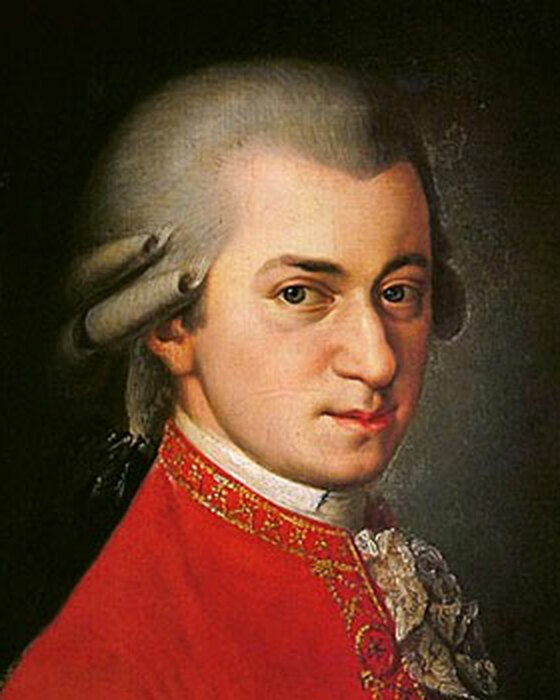
Wolfgang Amadeus Mozart
Born January 27, 1756 in Salzburg; died December 5, 1791 in Vienna.
Symphony No. 38 in D major, K. 504, “Prague”
- First performed on January 19, 1787 in Prague.
- First performed by the Des Moines Symphony on January 26, 1947 with Frank Noyes conducting.
(Duration: ca. 29 minutes)
“No work has ever created such a sensation as the Italian opera The Marriage of Figaro,” reported the Prague Oberpostamtszeitung on December 12, 1786. “Connoisseurs who have also seen this opera in Vienna assert that it has been done much better here. Word of this triumph must have reached the ears of Mozart himself, for rumor has it that he will come here in person to see the performance.” The rumor proved to be correct — Mozart and his wife, Constanze, left Vienna on January 8, 1787, and arrived in the Bohemian capital three days later. On January 17th, after a week of having been entertained, feted and lionized by the city’s nobility, Mozart put in a public appearance at the Prague Opera House for a performance of Figaro. “Word of his presence spread through the theater at once,” reported the local press, “and as soon as the Overture was finished, the whole audience broke into applause, honoring and welcoming him.” The response five days later, when he conducted his own opera from the keyboard, was tumultuous. It is not surprising that he told a friend, “Prague is indeed a very beautiful and agreeable place.”
As well as being a witness to the performances of Figaro in Prague, Mozart also hoped to present a concert of his instrumental music during his stay, so he brought along, among other items, a new symphony he had completed on December 6, 1786. With the help of his host in Prague, Count Johann Josef Thun (for whom he had written the “Linz” Symphony four years before), and the composer Franz Dussek, an acquaintance from his Salzburg days, Mozart was able to organize a program for his own benefit on January 19th at the local opera house. Mozart introduced the new symphony he had brought with him from Vienna, played some concerted works, and offered a half hour of improvisation at the keyboard, but the audience demanded more, so he extemporized a dozen brilliant variations on “Non più andrai” from Figaro. “The great artist perfectly fulfilled all that had been expected of him,” summarized one reviewer. Mozart stayed in Prague until mid-February, thoroughly enjoying what was one of the happiest times of his life. When he left, he took away not only the unstinting praises of the city and a substantial cache of earnings but also a contract from Pasquale Bondini, impresario of the Prague Opera, to write a new stage work for the fall season — Don Giovanni.
The Symphony (No. 38, D Major, K. 504) that Mozart premiered at his Prague concert, which has always borne the name of that city as its sobriquet, opens with an extended introduction whose turbulent moods presage the darker pages of Don Giovanni. Mozart, one of music’s most fecund melodists, is positively profligate with themes in the Allegro that comprises the main body of the movement. Musicologist Alfred Einstein counted “almost a dozen” motives that are welded into an expansive sonata form enriched by some of Mozart’s most masterful contrapuntal writing. The long-limbed and lyrical Andante, another fully developed sonata form, is one of those pieces of Mozart’s maturity that exquisitely balance an ineffable serenity with a whole world of pathos and poignant emotions. The quicksilver Finale, the third of the Symphony’s sonata forms, was a particular delight at its premiere to Figaro-mad Prague, since Mozart borrowed the theme for the movement from the opera’s Act II duet of Susanna and Cherubino, Aprite presto.
The score calls for flutes, oboes, bassoons, horns and trumpets in pairs, timpani and the usual strings, consisting of first violins, second violins, violas, violoncellos and double basses.
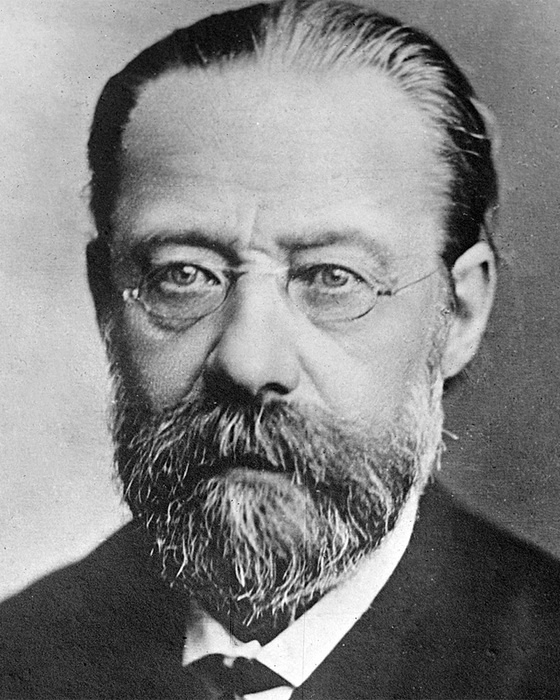
BedŘich Smetana
Born March 2, 1824 in Leitomischl, Bohemia; died May 12, 1884 in Prague.
Vltava (“The Moldau”) from Má Vlast (“My Country”)
- First performed on April 4, 1876 in Prague, conducted by Adolf Čech.
- First performed by the Des Moines Symphony on September 27, 2004 conducted by Joseph Giunta.
(Duration: ca. 12 minutes)
Early in 1874, Smetana began to suffer from severe headaches. This symptom came and went, and he noted no other physical problems until October. “One night I listened with great pleasure to Leo Delibes’ Le Roi l’a dit,” he reported. “When I returned home after the last act, I sat at the piano and improvised for an hour on whatever came into my head. The following morning I was stone deaf.” Smetana was terrified. He wrote to his friend J. Finch Thorne that a ceaseless rushing filled his head: “It is stronger when my brain is active and less noticeable when I am quiet. When I compose it is always in evidence.” He tried many unguents, ointments and treatments during the ensuing months but they brought no relief — Smetana did not hear a sound for the last decade of his life. He continued to compose, but withdrew more and more from the world as he realized he could not be cured, eventually losing his reason (in the margin of the score of the 1882 D Minor Quartet he scrawled, “Composed in a state of disordered nerves — the outcome of my deafness”) and ending his days in a mental ward.
It is one of the great ironies in 19th-century music that Smetana conceived the first melody for Má Vlast (“My Country”), the splendid cycle of six tone poems inspired by the land and lore of his native Bohemia, at the same time that he lost his hearing. Had he not been able to look to the example of the deaf Beethoven, he might well have abandoned the work, but he pressed on and completed Vyšehrad by November 1874 and immediately began The Moldau, which was finished in less than three weeks, on December 8th. Sárka and From Bohemia’s Woods & Meadows date from the following year; Tábor was finished in 1878 and Blaník in 1879.
The Moldau (“Vltava” in Czech) is the principal river of Czechoslovakia, rising in the hills in the south and flowing north through Prague to join with the Elbe. Smetana’s tone poem traces its inspiration to a country trip he took along the river in 1870, a junket that included an exhilarating boat ride through the churning waters of the St. John Rapids. The Moldau is in several sections intended to convey both the sense of a journey down the river and some of the sights seen along the way, as Smetana noted in his preface to the score:
“Two springs pour forth in the shade of the Bohemian Forest, one warm and gushing, the other cold and peaceful. Their waves, gaily flowing over rocky beds, join and glisten in the rays of the morning sun. The forest brook, hastening on, becomes the river Moldau. Coursing through Bohemia’s valleys, it grows into a mighty stream. Through thick woods it flows, as the gay sounds of the hunt and the notes of the hunter’s horn are heard ever nearer. It flows through grass-grown pastures and lowlands where a wedding feast is being celebrated with song and dance. At night, wood and water nymphs revel in its sparkling waves. Reflected on its surface are fortresses and castles — witnesses of bygone days of knightly splendor and the vanished glory of fighting times. At the St. John Rapids, the stream races ahead, winding through the cataracts, hewing out a path with its foaming waves through the rocky chasm into the broad river bed — finally, flowing on in majestic peace toward Prague and welcomed by the time-honored castle Vysehrad. [At this point in the work, Smetana recalled the main theme of the complete cycle’s preceding tone poem, entirely devoted to depicting the ruined castle and its aura of ancient battles and forgotten bards.] Then it vanishes far beyond the poet’s gaze.”
The score calls for flutes, oboes, clarinets, and bassoons in pairs plus piccolo, four horns, two trumpets, three trombones, tuba, timpani, bass drum, cymbals, triangle, harp and the usual strings.
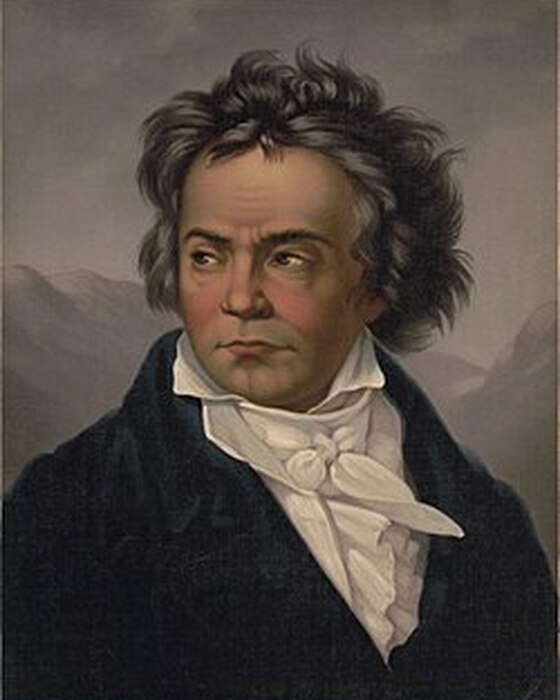
Ludwig van Beethoven
Born December 16, 1770 in Bonn; died March 26, 1827 in Vienna.
Violin Concerto in D major, Op. 61
- First performed on December 23, 1806 in Vienna, conducted by the composer with Franz Clement as soloist.
- First performed by the Des Moines Symphony on November 17, 1946 with Frank Noyes conducting and Carroll Glenn as soloist. Eight subsequent performances occurred, most recently on November 20 & 21, 2021 with Joseph Giunta conducting and Paul Huang as soloist.
(Duration: ca. 45 minutes)
In 1794, two years after he moved from Bonn to Vienna, Beethoven attended a concert by an Austrian violin prodigy named Franz Clement. To Clement, then fourteen years old, the young composer wrote, “Dear Clement! Go forth on the way which you hitherto have travelled so beautifully, so magnificently. Nature and art vie with each other in making you a great artist. Follow both and, never fear, you will reach the great — the greatest — goal possible to an artist here on earth. All wishes for your happiness, dear youth; and return soon, that I may again hear your dear, magnificent playing. Entirely your friend, L. v. Beethoven.”
Beethoven’s wish was soon granted. Clement was appointed conductor and concertmaster of the Theater-an-der-Wien in Vienna in 1802, where he was closely associated with Beethoven in the production of Fidelio and assisted him with the premiere of the Third Symphony. Clement, highly esteemed by his contemporaries as a violinist, musician and composer for his instrument, was also noted for his fabulous memory. One tale relates that Clement, after participating in a single performance of Haydn’s oratorio The Creation, wrote out a score for the entire work from memory. Of Clement’s style of violin performance, Boris Schwarz wrote, “His playing was graceful rather than vigorous, his tone small but expressive, and he possessed unfailing assurance and purity in high positions and exposed entrances.” It was for Clement that Beethoven produced his only Violin Concerto.
The sweet, lyrical nature and wide compass of the Concerto’s solo part were influenced by the polished style of Clement’s playing. The five soft taps on the timpani that open the work not only serve to establish the key and the rhythm of the movement, but also recur as a unifying phrase throughout. The main theme is introduced in the second measure by the woodwinds in a chorale-like setting. A transition, with rising scales in the winds and quicker rhythmic figures in the strings, accumulates a certain intensity before it quiets to usher in the second theme, another legato strophe entrusted to the woodwinds. The development is largely given over to wide-ranging figurations for the soloist. The recapitulation begins with a recall of the five drum strokes of the opening, here spread across the full orchestra sounding in unison.
Though the hymnal Larghetto is technically a theme and variations, it seems less like some earth-bound form than it does a floating constellation of ethereal tones, polished and hung against a velvet night sky with infinite care and flawless precision. Music of such limited dramatic contrast cannot be brought to a satisfactory conclusion in this context, and so here it leads without pause into the vivacious rondo-finale. The solo violin trots out the principal theme before it is taken over by the full orchestra. This jaunty tune returns three times, the last appearance forming a large coda.
The score calls for flute, pairs of oboes, clarinets, bassoons, horns, and trumpets, timpani, and the usual strings.